📍 80% of our health outcomes are socially determined. And by socially determined, I mean things that are not really under the control of the individual. the things like what neighborhood you are growing up in,
Mm-hmm.
how much money you have.
Race, geography, finance.
📍 Welcome to Lonely At the Top, a podcast for high level leaders carrying the invisible weight of the world. Because you know the higher you rise, the fewer people you can safely talk to. Here we welcome founders, executives, and decision makers who feel the isolation and pressure that comes with power.
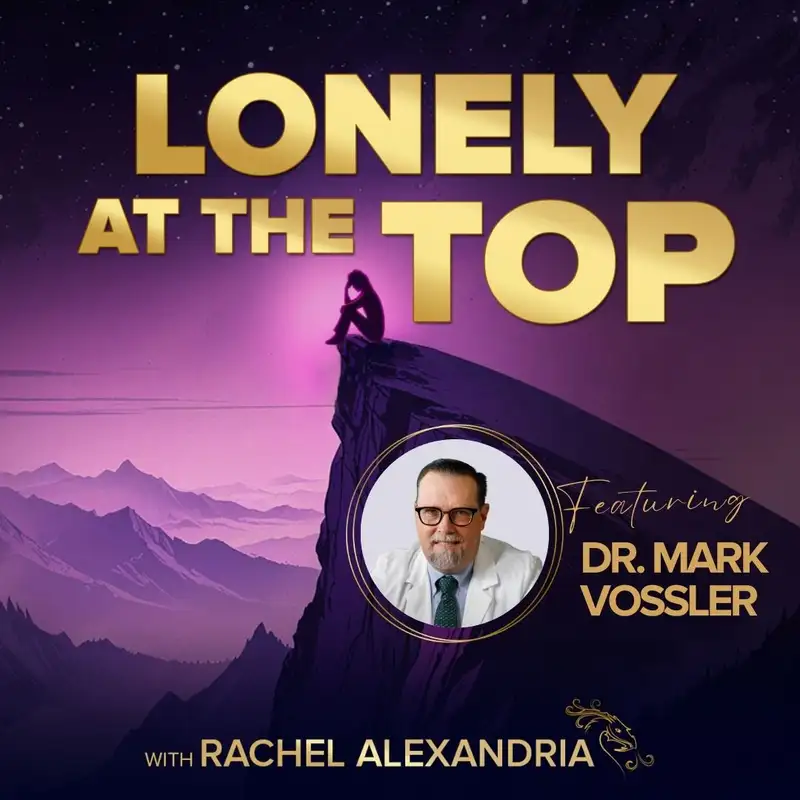
Lonely At the Top is your sanctuary in the storm, and I'm your host, Soul Medic and former psychotherapist, Rachel Alexandria. Today we have with us my friend Dr. Mark Vossler. He practiced cardiology in
Oregon and Washington for 30 years before retiring. He was the medical director of cardiac services at a community hospital for 10 years, and also has worked in public health advocacy work and held leadership positions with Physicians for Social Responsibility where he was also president of the Washington Chapter and now serves as president of the national organization.
I'm so excited to have this conversation also, 'cause we haven't talked in a while.
Well, thanks for having me, Rachel. I really appreciate the opportunity.
Absolutely. I should say, the way that we met each other was through a neighborhood political action group, basically because, at the start of the first Trump presidency when many of us with progressive politics, were pretty upset about what was going on, was trying to figure out how to do things like phone banking and getting out the vote, and how do we stand up and fight for what we believe in?
I got introduced to Mark, along with his wife Susan, and they were our wonderful hosts, and together we all put on a, a neighborhood action group for a few years, right.
Yeah, it was for a couple of years. And group is sort of merged into the local Indivisible chapter, but Susan and I are still going at it. We have not given up,
I mean, same just in different ways, right?
different ways. Right, exactly.
That was our way of knowing each other was volunteering together. And I just, really encountered Mark as a deeply, kind and thoughtful person. So I was like, I haven't spoken with anybody who's been much in the medical industry and you were in leadership there for quite a while.
I was, I was the medical director of cardiac services at my hospital for about a decade. And I mean, it started out, kind of rotated every, six months.
And so it was my turn and the guy that was up next had some family issues going on and really he couldn't step up. And he said, well, Mark, why don't you just do it another six months.
And the next thing I knew is a decade,
Wow.
spending, a fair chunk of my professional time, not actually seeing patients, but actually managing a department. Which is kind of cool. I'm glad to not be doing that anymore though.
Sure everybody gets tired eventually of whatever it is they were doing and needs a break. For those of us who, I'm just raising my hand here, mostly know about medical directors from shows like Grey's Anatomy. Can you, for those who aren't, are just listening, he just put his face in his hands.
Obviously that's a very exaggerated, hyperbolized, fictionalized version. Tell us what really a medical director does.
Yeah. It's not all glamor, right.
There's some things those TV shows capture. Like there's a lot of big egos in medicine. I mean, like working with a bunch of really smart people who by getting where they are, they're all overachievers. It's probably not that much different than say, managing team at Microsoft. Bunch of smart people. Everybody wants to be the boss, but no one wants to be the boss. You know what I mean?
And.
wanna, have things all their way, but they don't want all the responsibility.
Bazinga. That's exactly it. And I don't want to throw my, former partners under the bus. I worked with some really, really good people. But a lot of the day-to-day stuff was like, budgets and what equipment do you order for the cath lab and not Grey's Anatomy level stuff. pretty mundane, pretty boring.
I mean, that's kinda what you want, right? In any job, you want things to feel safe.
Right, and in medicine there's a lot of change that's going on and not all for the better. I think, some of the consolidation in healthcare systems big ones, buying up small ones, was, often good for the bottom line. Keeping the hospital open, but not necessarily better for the work environment, for doctors and nurses and at least where I worked, no net gain for the patients either way. So it's not all bad, it's just
medicine has become, much more corporate, much more big organization oriented rather than small practices or academic oriented over my career. So getting tired of that, I just decide what am I gonna do? I'm gonna retire and start managing physician activists instead of physician,
Yeah.
practitioners,
Yeah.
it's different, but lot the same.
You know, you're the first conduit through which I've heard of physician activists other than like, Doctors Without Borders.
Yeah,
Tell us what that means. What are physician activists?
yeah. Well, so it starts from, knowing a couple of basic things. Basic thing, number one is that 80% of our health outcomes are socially determined. And by socially determined, I mean it's not due to medical care. So 20% of how long you live and how well you live, has to do with my cholesterol pill or my blood pressure pill or my knee surgery. the other 80% isn't that. A lot of people when they think about the social determinants of health are thinking about, lifestyle. Like, I smoke too much, I drink too much, therefore I'm gonna have lung cancer and cirrhosis. True. But the bulk of the social determinants of health are really things that are society, not really under the control of the individual.
And I'm not saying everybody should go out start smoking and drinking,
Obviously not. Yeah. Nope.
that's bad for you. But, the things that one can't control, like what neighborhood you are growing up in,
Mm-hmm.
how much money you have.
Race, geography, finance. So what Physicians of Social Responsibility is , trying to do is advocate to decision makers to improve the social determinants of health. The biggest one and the founding principles, was around nuclear weapons because if we have nuclear war, the health system can't cope with that. We can't help the survivors of a nuclear attack. But then we broadened our scope into things like. Environmental toxins, climate change, and starting to work a little bit on the economic inequity end
of
things.
That's really cool. So basically as people who took an oath to help people heal and be okay health wise. You all feel a responsibility to help advocate for the 80% of things that are beyond your scope.
Yeah. And, and this notion got introduced to me in medical school, by one of our, professors he wasn't a clinician, he studied the history of medicine and kind of taught us about how changes in life expectancy were driven mostly by things like sanitation, vaccines. Very few surgical procedures or medications make even the top 100 list.
Wow.
So I already had it in my mind that it was for the role of the physician to actually be advocating not just for a healthy individual, but a healthy society.
See, this is what I'm saying. You're just such a good guy.
I didn't make this stuff up. I just joined the team.
You just joined the team and now lead a team and what we spend our time on matters. So when I asked you to be on the show, Lonely on the Top, did that resonate to you? Did you feel like you had some stories or some experience with that?
So yeah, it's, I think I alluded to the idea of like, you're here in this group and somebody needs to take charge of or a project, and you find yourself doing it, and like. Did I really volunteer for that? And if you get good at it, people ask you to keep doing it, and then they give you more and you do find yourself at the top. The world of managing, a basically a medical practice and the world of managing a, a volunteer driven organization with a small staff. There are similarities, but it's different in, a couple of ways. Can't fire a volunteer. You don't have that to hold over anybody's head.
Right. You're like, so if somebody says, if they, they volunteer for a project and say, you know, I'm gonna get this done. You can nag them. You said you'd get me this document a week ago and I haven't seen it.
Mm-hmm.
let 'em go. You could replace them with another volunteer, but I know, it's actually hard in business to let go an underperforming employee. But you do have that little bit of a threat that you don't have with organizing volunteers. And people can kind of, they can come and go drift in and out and like , if one of my physicians didn't show up for his cath lab procedures, they wouldn't be practicing anymore.
Right.
Mm-hmm.
You know, we had one guy who made a mistake of, uh, scheduling procedures at two different hospitals at the same time.
Oh no.
Yeah. That was a little bit of a scrum, but he didn't do it intentionally, but
Right.
Right. But if you're doing stuff, like, if you weren't carrying out your responsibilities in healthcare, it's really bad.
So people just didn't do that. Whereas in, in the volunteer, like, oh,
Yeah, I didn't get to it. I had a thing come up, it's the holidays, blah, blah, blah.
Exactly. So the style of management has to be somewhat different. You have to be a little bit more of a, cheerleader in the volunteer. Right? The volunteer series. You gotta
Mm-hmm.
asking people twice and thanking 'em 10 times, for everything they do, which is, I'm not complaining about that, but that's how you get things done. Uh, keeping people motivated. The other challenge I face, in health-based advocacy is some of this stuff is just downright depressing.
Like, you know, talking about climate change at parties doesn't make me popular.
What
And
I.
you got, you're dealing with existential threats, like Oh 15 miles away from the largest collection in nuclear weapons in the Western Hemisphere you tell people that and like, oh, well, uh, a nice day. Uh, so, you know, so we think about these things like climate change, nuclear war that I work on. And then to factor in kind of the current very nasty, partisan political climate
Mm-hmm.
capital. And you're like trying to work on this stuff. It's easy to have people just say, I'm just gonna give up.
I can't do this. So you have to always be thinking about positive actions. Am I doing something that's gonna actually have an impact? And if you got something that's actually gonna have an impact, get people to go along with you. 'cause it actually, psychologically just sit there and read the news over and over again is crushing. Um, and so the, the people I work with at PSR, they care, they're highly motivated. They're very worried, and there's that fine line between being worried enough to act and so worried that it paralyzes you.
So you are trying to, as a leader, help people navigate that.
Yeah. In a way, and I think to be effective, the two things I, do to stay effective in that one self-care, I gotta make sure that I don't overbook myself and make time for some physical activity every day, some meditation every day, little time playing my music every day, a little me time. And since I'm retired from clinical practice, I control my schedule. I can do that. Not every executive can say, well, I'm just gonna practice my guitar for 30 minutes. But, a little bit of that doing stuff that has absolutely nothing to do with the scary shit. The second thing, and I highly recommend this to everybody, is limit your news consumption.
Yeah.
Limit your time on social media to small chunks of the day. And what I do is when I get up in the morning, I have a cup of coffee and I read The Economist Daily Briefing and Heather Cox Richardson, and then I'm done. That's my news. I don't look at the news. Then it's all action.
After that I, you know,
Nice.
and all action. A little bit of news, something that takes my mind off of it, and then working on the things I work on helps me cope. Now that's not necessarily the schedule for everybody, but when I see people that are kind of picking up their phones and looking at Apple News all day long, dude, you gotta stop that. It's, it's driving you nuts.
Yeah.
you nuts and it's repetitive, right? It's the same stuff over and over again. So definitely want some news breaks.
You are really primed to share how people can take better care of themselves. I really hear that and how you are doing it, and I love that. I am wondering what is a season or a time of leadership that really challenged you?
Running a nonprofit advocacy organization
during
the pandemic,
was it, it was difficult. It doubled down. We had some issues with staff interactions at the time. Our current staff at our Washington chapter, they're fantastic. Good working relationships. We had some bad working relationships and I found myself in the position of running interference between the executive director and problematic staff members. I used to tell myself, I didn't sign up for this. I'm doing this to, solve climate change. Not to, deal with somebody's personality quirks. Uh, it was,
That's the thing, right? You get into business or you get into any organization thinking, I'm here for the mission, or at least some people do. I'm here for the mission, not for all this people stuff.
Yeah, but the people stuff is how you get things done. And if you think about the mission in I'm working on now, well, what I was doing before is all people stuff, medicine's, people stuff. All the
It is.
who came back, he had aed, hard day in clinic, he slams on this is when we had paper charts back in the day. He slams up the chart, he just And then he says, medicine would be perfect if it weren't for the patients. Your direction was in the exam room, but this patient did something to tick him off. Like, like, like yeah. It's, it's the people stuff that you know, makes a difference. Right. And if you go beyond just kind of these challenging moments in management where
why is this my job to negotiate between these two warring parties, if you will. Well, I take a next step. I take outside of that. Where we're most effective as physician advocates is when we go to decision makers, we go to, our state legislators or members of Congress, we say, this problem really is a human health problem, and you need to solve it because it's killing people and we have a unique voice there. But that's all, all that stuff is about building relationships, building trust, using your credibility. It's important that I know the medical stuff. It's way more important that I know how to get along with people. getting that sort of
Yeah.
and getting the advocacy work done. And so it's both, managing a team then going out, doing the work with the people that we call on to make a difference. It's all human interactions. It's all people skills.
I think probably plenty of leaders understand, but a lot of people who are not in leadership positions don't necessarily think about how much of your job, whether it's in a volunteer organization or anywhere else, is just really about navigating personalities and, you know, figuring out who needs to hear what in what way to get this to move forward.
I.
Yeah. There was a moment in time that, we're working on a particular bill in Congress and one of my colleagues, he couldn't get why our congresswoman wasn't endorsing this bill 'cause it made so much sense and it was damnit the right thing to do and said, you know, maybe she doesn't understand all these things that are happening with climate change.
So he had all these graphs he wanted to show her like, no, that's not it. She knows that we've already showed and he was building these persuasive arguments like, know, you don't get it. The problem is it's not her. It's how it would look to the rest of the voters if she did this.
And are there enough people that agree with taking this action that she won't get burned in the next election? Has nothing to do with the charts and graphs. So it's,
Yeah.
all about building trust and you know, movement, building, bringing more, more people along to speak up, not the charts and graphs
Yeah. That's the thing, right? A lot of people who are really good at their jobs or experts in their field think that the facts should be persuasive when the truth is people are rarely persuaded by facts.
Right,
That's, that's not most people, that's just not how we work.
Yeah, yeah.
persuaded by relationship, by feeling understood and heard. And it's complicated for those of us who are people who sit in expertise like,
right,
no, I want to know facts. I want to understand what is truth or as much as possible, right?
yeah, yeah. You know, when I look or reflect back on my clinical practice, patients cared that I knew what I was doing, but the court sort of assumed. I had the knowledge
Mm-hmm.
of what was most important is that they felt like I cared about how they were doing. And I'm far from perfect, there are moments where I was rushed or a little brusque you lose trust.
And I say, this guy, he may know his stuff, but he doesn't care about me.
Mm-hmm.
that's a big deal. It's a big deal and so I think knowing that helps translate into the sort of work I'm doing now that people have to believe you care.
Yeah. Yeah. I mean, absolutely.
It's hard to fake caring by the way.
That is true. That is true. I mean, in order to really fake caring, you kind of have to be a psychopath or, or somebody who completely lacks empathy or I suppose like an excellent actor. But yeah, no, it's the same with my profession, you know everybody who's in, my field, psychotherapy and mental health, wellness work, whatever.
People get very fixated on like, oh, I have to go get this certification or this degree or this license. And yeah, there's certain basic things you have to do to practice, that is true depending on what thing you're doing, but beyond me having a degree, people don't care what I'm certified in or whatever
Right,
they want a tiny bit of information to just, you know.
Broker that trust, but the majority of the connections that I make, and the reason that I'm able to,
Right,
for example, have these conversations is because people are seeing that I care about them and that I'm interested.
And one thing that we have to remember we are going beyond our professional lives and we're kind of working in the political realm.
Mm-hmm.
Politicians are actually people too.
Yeah.
And they have, real emotions. And if what you do is you go into a meeting and you just pile on with the negatives and tell them all of that, they're doing wrong.
Mm-hmm.
you feel if I come into this conversation with you and I tell you what a horrible human being you are and how everything you've done for the last three months is awful.
Mm-hmm.
kind of clam up and really aren't very receptive to my requests.
Yeah.
so it in politics, treating other people like real people with real feelings goes a hell of a long way. Goes a hell of a long way.
Did you ever see that clip of Fred Rogers going and advocating for PBS with whoever the senator was, for folks who haven't seen it? I watched the Mr. Rogers documentary and immediately started crying the second I heard his voice, but there's this great thing where he, went to Congress to advocate for PBS to have funding and just
shared with the, whoever the ranking, the committee lead was. Uh, and it's all on camera, and him sharing about what they teach children, but it's not what he shared. It's how he shared it and how he treated
right.
And you could see the man become very physically affected,
Right,
know, and be like, oh. You're speaking to me and you're treating me with this kindness and this compassion, and I'm your friend and your peer. You could just see him. It's not what Fred Rogers said. Mr. Rogers said it was how he said it.
It even if the person you're talking to has never done as far as you're concerned, anything good ever in their life. At least thank them in the meeting,
Yeah. Yeah.
thank you . How is your day going? It's a golden rule thing. Treat people how you wanna be
How you'd like to be treated. Yeah.
The second thing that I can't emphasize enough in the political arena is you don't make change by talking only to people who agree with you.
Oh, for sure.
Like that's not change.
That's just like it's preaching to the choir.
Mm-hmm.
you have to reach out and make connections with people who hold adversarial opinions. who may throw you out of their office, you know, you gotta take those risks. Sometimes, and this is an example I use, sometimes you have to work with people that might be unsavory characters in one way or another.
And you don't have to sell out, but you know. Lyndon Johnson was an asshole, but he also, he got a couple of big pieces of civil rights legislation passed. Doesn't keep him from like total jerk, the way he treated
Totally.
he treated his wife,
Yeah.
way he treated a lot of his colleagues, but he got some stuff done that was good. Okay, so if let's just say you're John Lewis or Martin Luther King back at that time, like, yeah, we gotta go meet with Lyndon Johnson. Now we're not gonna
Mm-hmm.
Let's just have another march. Well, yeah, the marches got public attention, right? Got public attention. But
Sure.
talking to this unsavory character was a
Mm-hmm.
what they did, that, that, that continuous pressure.
So I remind myself that, you know, yeah, Martin Luther King took those meetings with Lyndon Johnson that it probably wasn't fun,
Yeah,
but.
but it did something. It accomplished something. Okay, so when you're in leadership, no one sees your balance sheet of burdens. They just see what you present to them, right? So here we like to open the private ledger. I like to ask our guests a couple questions from their private ledger.
Can I ask, what is one cost you paid for being in leadership?
There are fewer family costs with what I'm doing now, particularly 'cause my wife does, she's on the board of another nonprofit. Like we, we do this stuff and then we commiserate about, oh my God, I can't believe they said this in the meeting sort of things. I think back when I had younger kids and I took on not just a heavy clinical burden, but the management parts that was sometimes stressful but not horrific. I could have let it get really damaging and I think it was very important to say, Hey, this is my time with my wife and kids. And you don't get to intrude on that. And in some ways that was easier with my clinical work, I'm like, I'm not on call. I'm Out in some cabin in the woods with the kids and we're skiing. People don't bother me with clinical questions. They bother me with management questions and usually the things that intrude on family life are the least pleasant aspects. And I bet you this is true of everybody that comes on your pod, the things that disrupt you at 8:00 PM on a Saturday are things you really don't wanna have to deal with.
Yeah. No one ever calls you at 8:00 PM on a Saturday to say, guess what? We have a surplus in our revenue.
no, it's u usually that, your immediate report is quitting
Hmm.
Is, you know, having an affair with the hospital CEO's wife or whatever. that didn't happen. Like,
That's a Grey's Anatomy plot, but I'm sure it does sometimes happen.
I'm sure it does, but it's like, deals gone sideways. They tend to go sideways at 8:00 PM on a Saturday. The good thing is, I. It kind of is an emotional burden, but it didn't really let it have much of an impact on my family. And it didn't damage anybody. Yeah. It didn't damage my relationships. You know, coming out the end of that physician management career I feel like I've learned more from that than I lost, and it's made me more skilled in the things that I wanna do in my retirement. The things that I'm doing right now, that experience has made me better at what I do now. Now if I think I rewind, I say they're painful moments. I didn't lose financially, I was compensated for it, you know? I was paid just as well as the folks that were only seeing patients. because I, I worked at it. I didn't let it have significant adverse impacts on my family, but is so easy to have that not be the case. And I've had colleagues where their devotion to their mission means means that they ignore the other aspects of your life. And you know what's really problematic with that is then you get old and say, oh, I'm retired. Like, what the hell did you do? Nothing else in your life. I see that a lot with physicians, can't leave practice because their whole identity is
Mm-hmm.
the doctor identity.
So it sounds like one of the costs you paid was all of the internal emotional and management labor to make sure you were in balance.
That's, yeah, that is it. And you gotta, just, like I said, you gotta be intentional about carving time out for your family. You gotta be intentional about carving time out for you. It's way easier now
because you know, essentially what I'm doing now is part-time management work, not full-time.
So it's easier for me to practice healthy habits like meditation, exercise, and music, which are mine. Those don't have to be everybody's habits, but something along those lines. Right. For everybody.
So tell us one invisible asset you didn't realize you had at that time, like in the past. What is an invisible asset that you now see you had?
For reasons it's still baffle me people seem to like me and I don't, I don't know why. I have no idea what it is, but people seem to think I'm a good guy and I could be a real jerk, but people still think I'm a good guy and I don't know. There must be something but that's an asset. And so I, I get away with some other stuff 'cause people genuinely like me. but if you, if you ask, well, how do you make people like that? I have no idea. They just, they do. And I don't wake up every morning and say, I want more people to like me, but
Sure.
that has served so damn well in everything we have just talked about.
Because people give you the benefit. They think, well, Mark, he's a good guy. We'll give him the benefit of the doubt. I could have the stupidest idea on the planet. They'd say, well we ought to at least consider it. 'cause Mark brought it up don't tell me how I achieved this 'cause I have no clue.
I have absolutely no clue. And
So if you were my client, this is where I would challenge you right now. This is where I'd come for you.
yeah.
just saying my, my clients, if they're listening to this, they're like, Ooh. Rachel would be like, let me, get settled and let's get in there. You know why? On some level, if I described to you the kind of person that you are and we laid out the feedback you get, I think you'd be able to name why.
Yeah, I probably, if I worked at it, I could probably figure it out. I guess when I say the invisible, it's not. I didn't really try to like say, oh, I'm gonna be likable today.
Sure.
it comes you know how some things come easy
Mm-hmm.
people and some things
some things are harder. Yeah. Everybody's got a thing that's easy for them, and this is one that's easy for you.
I'll give you, like, this is an example in my music. I, I cannot strum well while singing, but I can play solos better than most other amateur guitar players so I get together a group of people and like, oh geez, I just gotta put, put that away if I am, it's time to sing. And so getting, acquiring that skill, I actually have to work at that skill that seems to like other people.
They fall off a log with it, and so I, I think, yeah, there's just things in life you have to work harder on. It's, you know, like harder to learn math than English
Some people have to work harder , to be likable, and some people it's just their nature. I mean, we could have a whole side conversation about the Enneagram here because I bet that has a lot to do with it. The type you come in as some people are just very. Very likable, you know?
here's my hypothesis. A lot of that's how people have treated you growing up.
I would argue against that. Sure. Yeah. Like what I would say there is some amount of that that is just inherent in people's nature. There is a component of our personality we are just born with. So that's a really good description of an invisible asset, a thing that you just fall off the log doing, like you just Yeah, and, and I totally agree.
You know, I think one of the things that makes you so likable is that you genuinely care about other people. And that is not a thing you can fake. It makes people like you.
I would agree. You can't fake caring, so yeah. That's, that's just in me. Whereas it took training to learn how to do a heart cath. That guy got pretty darn good at it.
You didn't pull off a log knowing how to do a heart cath?.
No, you don't. In fact, it's scary. Like you're putting art, you're putting these people's blood vessels and up to their heart, and that concept kind of freaks you out at first, and it takes training, but once you get good at it, it's not that hard. Uh, but you don't come out, at birth able to do complex medical procedures.
No. I've watched a lot of Scrubs, and they always say Scrubs is the most accurate in terms of portraying experiences that people have as they're learning medicine.
The most accurate TV show I've seen medical TV show ever was Pitt, The Pitt.
I knew you were gonna say that. I knew you were gonna say The Pitt. Okay. But have you watched Scrubs?
I have. The Pitt's better.
Oh
Yeah.
man, if Bill Lawrence is listening, creator of Scrubs, the gauntlet's been thrown because Scrubs is coming out with with a new one.
it, it's more irreverent Pitt's more gory,
Sure. Yeah. But what I was thinking of is in Scrubs, how the doctors, when they're still interns and they're training, they're in the closet, freaking out, hiding from things that they're too scared to do.
When I was a med student on my surgical rotation, the senior resident yelled at me because I forget what I forgot to check a lab or something, and I was like, in frigging tears. Yeah, no, some of those moments were horrible,
Okay, let's, keep going the last question from the private ledger. I feel like you've talked about it, but in case there's something you haven't added, an investment you're making now for your wellbeing or your soul?
Yeah. I mean, we touched on some things like that. When we talk about self-care, it's not all about how you feel today. Some of it is, you know, just taking a break from the stress, like getting away from the media. But I think, as I get older and I kind of knew this stuff as a young physician, but as I get older and I start thinking about me as the patient, think about what's called health span as opposed to lifespan and health span is like how long you live with good health, able to do the things you want. And I think physical activity is really important for that. Let's say, every fall, I love going up on these hikes in the Cascade Mountains where the Larches are the turned golden. If I wanted to a 10 mile hike every October in the mountains, I better go for a walk every day. Or I won't be able to do that anymore.
I won't be able to enjoy that anymore. And so what motivates me to build a little bit of physical exercise into every single day is I want to be able to be as physically active for the rest of my life. And there's good science that supports that,
Yeah.
that people that are more active when they're 60 are less likely to be disabled when they're 70 or 80.
Yeah. Shout out to my mom here who does, regular, five to eight mile hikes and has ever since she retired, and in her mid seventies and is just thriving. It's great.
aspect of this
Yeah.
that I tried to buiI'ved into my routines is picking up some heavy things from time to time. I remember being at a dinner party and there were a couple of people just, they weren't that much older than me, but there's two older ladies chatting about how they're having difficulty putting dishes up in the upper
On the upper shelf. Yeah.
think like you can't put some dishes, how do you get your bags and the overhead bin on the airplane? Like, not letting yourself go strength wise as well. And so daily physical activity is an investment in your lifetime and, I'd advise everybody .
This is the cardiologist side, not the public health advocate. Well, a little bit of that but a cardiologist, telling you you should get off your butt and go, go to the gym and pick up some dumbbells and go out, go for a walk in the woods. Those are the best things you can do.
Love it. Love it. I have dumbbells in my house 'cause I am in pain if I do not lift heavy weights. So
Yeah.
gotta get those tendons and ligaments, lengthened. Okay.
lotion.
Two more questions. Yes? Yes.
Yeah.
What do you wish more leaders felt permission to say out loud?
You're already, like, say you're already heading a team or a department or, and somebody asks you to join another interdisciplinary committee. You gotta know to say, no. I, I feel empowered. I could have said no to you to coming outta your pod if I was too busy this week. Right. But I, I personally. I've said yes , not that loving this, but I've said yes to things like, why did I say yes to this? I'm not even interested in this stuff. So more
Yeah.
people in an executive positions need to feel empowered to say, no, I can't do that one.
I, yeah, co-signed. Okay. Before we do the last question, I just wanna check in, I offer every guest the chance, if someone's listening to this and they wanna get connected with you or get involved in your cause,
Yeah.
is there some way you would like them to do that?
o
Yeah. psr.org. It'll be in the show notes. That's Physicians for Social Responsibility.
Yeah.
And do you want people to connect with you on LinkedIn?
They can, I'm on LinkedIn. I don't use it as much as I should. The other way wpsr@wpsr.org. That's the Washington chapter wpsr@wpsr.org. Great way to get ahold of me, probably better to use that
so you said wpsr
wpsr@wpsr.org
Got you. Okay.
yeah.
So here's the last question. We're gonna open the time machine.
If you can step into this time machine and go back to any point in your past, where would you go back and what would you say to yourself?
I did so many dumb things when I was young, but I got away with it 'cause I ended up in a good place. There was a stressful point in time when I was juggling, young kids. I was doing, molecular biology research at the time. I had my clinical practice. I had the science, I had the kids and everything was getting busy and it was overwhelm. And 1998 1998 Mark, I would've said, you don't have to do all these things. You can pick two outta three. Focus on that. I ended up, you know, doing okay, but I was super stressed out about just being overwhelmed with all the things I had to do. And a little reassurance from, you know, now that I have gray hair, would've been kind of cool.
Well, thank you for coming on the show and sharing your wisdom and experience. It's been really enjoyable to chat with you.
📍 Thanks for listening to Lonely At the Top. If today's conversation resonated, I hope you'll give yourself permission to pause even just for a moment and check in with what you might be carrying silently. You don't have to hold it all alone.
I work with high performers and leaders who wanna clean up their secret messes. You can learn more at RachelAlexandria.com. If you know another leader who needs to hear this show, send it their way because, yeah, it's lonely at the top, but it doesn't have to stay that way.