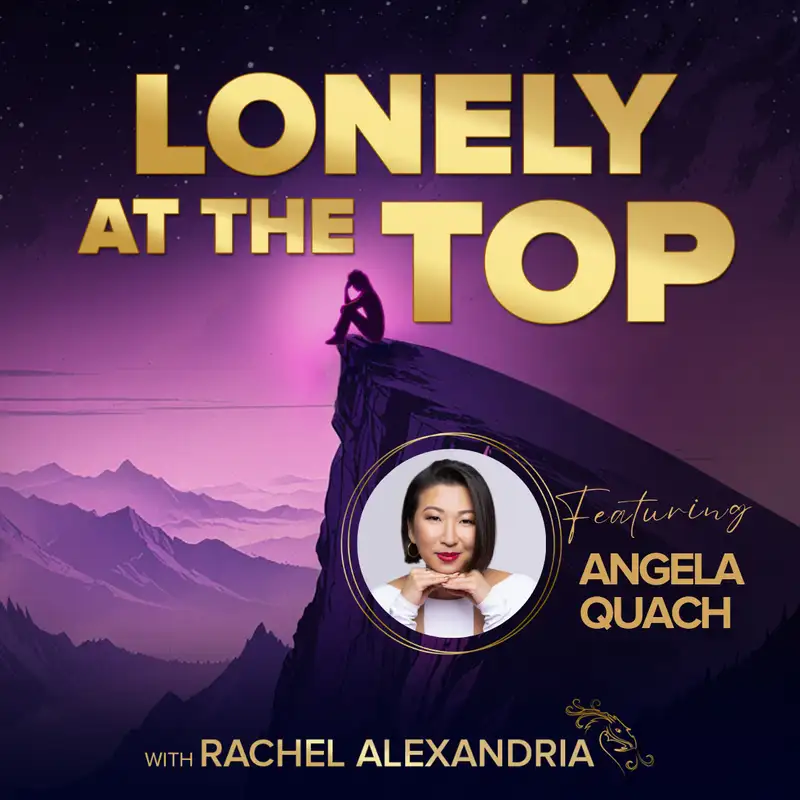
Angela Quach: [00:00:00] I just believe that visionary leadership means holding the purpose and the pressure. You know, you can be ambitious and still need support so you can dream big and, and still feel doubt. That's not weakness. That's the weight of building something that matters.
Rachel Alexandria: Welcome to Lonely at the Top, the podcast where high level leaders speak the truths they rarely get to say out loud. I'm your host, Rachel Alexandria, former psychotherapist turned soul medic to founders, executives, and decision makers, helping them clean up their secret messes and navigating the emotional weight of leadership. you've ever felt the strain of being responsible for everything and no one you can really talk to about it, this is the right place for you. In each episode, we go behind the curtain with a courageous leader to explore the real cost of holding power what it takes to stay human at the top.
Today's [00:01:00] guest is Angela Quach, the founder and CEO of Destiny Lab, multi-million dollar marketing agency specializing in brands with purpose. distinguished Korean American entrepreneur and DEI activist. She's been recognized as a Forbes business coach and has led brand strategy for names like Tony Robbins, DirecTV. At t and the Earl B Gim Barr Foundation. Born in Ohio to working class immigrant parents, Angela's rise reflects both grit and vision. Today she's on a mission to build a more equitable business world one bold idea at a time. Hello, my lovely Angela.
Angela Quach: Hello, Rachel. Thank you for having me
Rachel Alexandria: I'm so glad you're here. So I wanted you to be one of my first interviews on the podcast because we are, surprise to viewers, and [00:02:00] listeners, we are friends in real life.
Angela Quach: in
Rachel Alexandria: I,
Angela Quach: life. Yes.
Rachel Alexandria: I knew Angela like before, before when she was still an impressive, I wanna say corporate climber I
Angela Quach: Mm-hmm. Yes,
Rachel Alexandria: before she
Angela Quach: So.
Rachel Alexandria: the amazing CEO she is today, and I wanted to talk to her about it. So tell us just a little bit about your background. I hit it in your introduction, what was it like for you growing up with working class immigrant parents in Ohio? Now you're in, you know, you've been to San Francisco and San Diego and Dubai.
You've been all over the place. But take us just for a moment, back to the beginning.
Angela Quach: Wow. Well, it, it's been an amazing journey of gratitude. I would say that my journey is not very different from a lot of others. Especially, kids [00:03:00] who were raised by immigrant parents. So I grew up in Columbus, Ohio to humble, working class roots. My parents made less than $20,000 a year in salary.
So, I mean, we were poor with a capital P but you don't know that growing up, right? It's just like it's a lifestyle for you. So, really the way out for me was through education. I am a proud byproduct of affirmative action. Someone at the top created a lane of access for me to succeed based on merit and not resources.
So from there I received an academic scholarship at the Ohio State University, and that put me on a journey as, uh, a business consultant. And it opened me up to avenues for traveling, for projects that I probably would've never been exposed to. Opportunities of a lifetime. You know, if there was an opportunity, I definitely seized it.
Um, and, [00:04:00] and that was my mindset. And I, I came into the corporate world really wanting to prove myself. You know, especially in my twenties. I was so hungry for respect, for money, for access for all these things, for power, influence, leadership roles. So to say I worked my butt off is an understatement and, um, I just had a lot to prove, what I believed at that time
I had a lot to prove. And I did pretty well for myself. I started off as a manager, worked my way up to agency director for a marketing agency, Max Borgess Agency, where I handled large accounts and things like that. And, I really had a change of heart from corporate to entrepreneur when I started working for, a well-known name by the name of Tony Robbins.
He's a well-known life coach in the life coaching [00:05:00] industry, and it was something I had manifested, like I had a vision of working for the best life coaches out there and. I had either Tony Robbins or Oprah and I, and I really hit the nail. Just submitting my resume, being very aggressive with follow up and, and putting myself out there.
And what I realized working for Tony as his producer for two years, which is a man I respect very well, is that. This is a man who has a vision and understands how to execute it, and he is not shy about his vision and his dream. And being an entrepreneur is not for everyone, but I do believe that we can all be leaders
of our own journey, of our own desires and dreams. So I have plenty of friends who are still in corporate, who are now VPs and presidents. And to them that is their dream.
Rachel Alexandria: Mm-hmm.
Angela Quach: for me, I [00:06:00] had to be authentic and honest with myself and say, my dream is to start my own business from the ground up. And that's what I did.
Rachel Alexandria: you, you then did, yeah. I met you when were still working for Tony
Angela Quach: Mm-hmm.
Rachel Alexandria: You had just moved to San Diego and you were like, you know what? I really wanna do my own thing. And I was like, oh my gosh, that's a big leap. You know? And you were like, I'm gonna make this company not, I mean, I've been working for myself for almost 20 years,
Angela Quach: Mm-hmm.
Rachel Alexandria: this is just basically me and some contractors, uh, and you were like, no, I'm gonna build a company.
And I was like, privately, I was a little bit, you know. I didn't understand how much drive and intelligence you were really gonna bring to this. I had no idea. I had never watched someone go from being employed and never having been an [00:07:00] entrepreneur to within six months having a company with employees and actually killing it.
I have never seen that in my life, and I've been an entrepreneur for 20 years.
Angela Quach: Thank you. Thank you.
Rachel Alexandria: It was remarkable. Like I really, I wasn't doubting that you could eventually get there, but I was like, what's she gonna do for money in the meantime? And you were like, no man, I'm making this work right now. Yeah.
Angela Quach: Yes. Yeah, I, I attribute a lot of that to , the universe, having faith first and foremost, which we can definitely dive into, and also extreme resilience. Extreme resilience because even in those six months, each day of those six months, you're not sure what the outcome is going to be. And I was living day to day. I was not as financially literate as I am today, and so I was living off a very minimal amount of savings. And I had to make sacrifices. I [00:08:00] decided that if I was gonna start my own business, every dollar counted. I downgraded to an apartment with two other roommates. I used every dollar I could to reinvest back into my business.
So I believe that if you do want something to work, I truly believe that anything is possible, but we have to walk in faith that it is. Mm-hmm.
Rachel Alexandria: so what I want to remark on, pertinent to the topic of this show is that I knew you while you were doing this, and in fact, sometimes we worked together and I did not know, 'cause we rarely talked about business. We were always talking about personal stuff, right? I didn't even know what you were going through or what you were having to handle.
Angela Quach: Yes.
Rachel Alexandria: you were establishing yourself as a leader in your company. Did you experience that as [00:09:00] difficult or lonely at the time?
Angela Quach: Absolutely. And I think it only amplified that feeling starting my business during the pandemic. So it was loneliness on this journey of entrepreneurship and loneliness, just with the social conditions that we were living in during those times. But I'll, I'll just focus on
being an entrepreneur. You know, when you have a vision for your life and you are genuinely authentic and vulnerable to the desires of your vision. It's a very, very vulnerable feeling and not everyone is going to understand. Just like you said, you are my dearest, dearest friend Rachel. Like everything about you just emanates support and love and light and abundance, but not even, you could grasp like [00:10:00] what my dream truly was, and that is not your work to do.
That that is not your job. That is truly my job. So when people say it starts with mindset, I completely and fully subscribe because the world is going to constantly test you to say, how bad do you want it? How bad do you really, really want this? And. I believe everything that I've worked through in my life, the conditions that I, you know, was raised in sometimes I did question why life wasn't a little more entitling for me.
But I completely understand now because if you wanna do your own thing, you have a vision for your life, for your business, for your company. It's going to require that you overcome hardships. It's just an inevitable part of any journey, especially a hero's [00:11:00] journey, an entrepreneur's journey. So we all have to develop this muscle, this muscle to overcome.
Rachel Alexandria: I know what you're talking about. When I first started my business, I mean, being a therapist wasn't hard for people to understand. They were like, oh, okay yeah, that's an understood path. But when I how I was working I was like, no, I'm not just a therapist. Here's what I'm doing with people.
Here's how that's functioning. It took a long time for people to see what I was creating. Yeah. So I, I get that there is a loneliness in being a visionary because no one else will see it until it's already made.
Angela Quach: Mm-hmm.
Rachel Alexandria: During the whole making process, you are the one alone who has to hold that.
Angela Quach: Yes. And I'm also a DEI activist, I'm an entrepreneur and
I [00:12:00] just believe that visionary leadership means holding the purpose and the pressure. You know, you can be ambitious and still need support so you can dream big and, and still feel doubt. That's not weakness. That's the weight of building something that matters.
Rachel Alexandria: Yeah. Oh my gosh. That is, that is so true. Well, let's talk about holding that weight and that has been like for you. So can you share with us leadership decision or a leadership season that really tested you? Like a specific example,
Angela Quach: Oh my gosh, there's so many.
Rachel Alexandria: right?
Angela Quach: I, I, I'll start from the beginning. So I think, what I find really common with a lot of my entrepreneur friends and something that I had to overcome myself is building a team. Or building a dream [00:13:00] team, getting people on board with what you're building. This can be in the sense of suppliers, contractors, teammates, board members, friends, loved ones, whoever.
This is what I tell myself. It only feels real when it's in the real world. Yeah, so we cultivate it within ourselves. We have a dream, we have a vision, we can work on it late at night, on our Google Docs or on our Canva, and we build a website for it. But it becomes real when we start integrating it into the real world.
And that takes people
Rachel Alexandria: Mm-hmm.
Angela Quach: And that takes people coming on board. And delegation was very, very hard for me because I was missed do it all. I could do it all. There is nothing I cannot do. I can send the email while I make a cold call, while I update the website, while I send invoices, and
[00:14:00] that is great to get you where you need to go to a certain point. But there comes a point where you have to say, my business is so worthy of more resources. Whether that's charging more, whether that's bringing on more teammates, whether that's getting investment. My business is so worthy of investment of, of putting a team together, so we have to get, I had to get out of that
kind of like fear mindset, do it all myself, save a penny, and I, I can do it all. Because what I was eventually becoming was the own choke hold to my business. I was delaying things. I knew things could be more efficient. I knew things could be, you know, better done
Rachel Alexandria: Mm,
Angela Quach: design wise.
Rachel Alexandria: it out of your tight little hands. 'cause you're like, no, I'm the only one who can do stuff, because that used to be the case.
Angela Quach: [00:15:00] Exactly, so who I was then to get where I needed to go is not who I needed to be now to grow the business. It's a huge identity shift. And so at some point I needed to stop being the leader that did it all and start being the leader that my business really needed, and to start trusting people. So I think being a good
CEO or leader is not about control. It's about trust. So I had to find the right teammates to bring onto my team. So it, it became, my mindset no longer became getting it all done. It became putting the right people in the right places. And that takes a lot of courage just internal courage to get into that mindset.
And it was very vulnerable for me to open up to people and say, Hey, I'm starting a marketing agency. We're a startup. This is our vision. This is how we're going to grow and do you wanna be a part of [00:16:00] this?
Rachel Alexandria: Mm. Yeah, it's, it is incredibly vulnerable, right? To
Angela Quach: Mm-hmm.
Rachel Alexandria: to start something and ask people to believe in it, and then trust them to help your baby
Angela Quach: Mm-hmm.
Rachel Alexandria: right?
Angela Quach: Yes.
Rachel Alexandria: Yeah.
Angela Quach: And finding the right contractors who understand what you're trying to execute. This is a whole game as well.
Rachel Alexandria: how did you learn to navigate that trust?
Angela Quach: Something I'm still learning, but I would say, I think to vouch for people quickly.
Rachel Alexandria: Mm-hmm.
Angela Quach: Would require having a vetting process that I believed in. So my vetting process , metaphorically speaking, in terms of business, I would just kind of jump into bed with people and offer them these huge projects with really no idea what they [00:17:00] were capable of or how they were going to execute.
Even if they came highly recommended or they had great, a great website or great marketing, I still didn't know how our dynamic would be, so what I've learned is to slow down is what I still tell myself. But to slow down and start with small projects,
Rachel Alexandria: Mm-hmm.
Angela Quach: because there's a saying which is, slow is smooth and smooth is fast.
So I would get to know my contractors, whether I met them at conferences or I met them at business workshops. Referrals through friends and peers. We would start with one project, very, very small. And you can learn a lot about a person just through small interactions. And I started to learn to not overextend myself, not overextend my [00:18:00] budget, not overextend my
my coaching. I, I used to coach suppliers, you know, like, I used to really be very, very forgiving. And so there's a level of accountability I had to start holding people to, which is do you understand where I wanna go? Are you gonna treat me like the client, you know?
Rachel Alexandria: Yeah, and that's, it's hard, I think, especially for women to move from this place of trying to befriend everybody so that they like us, so that we all get along to being somebody who says, Hey, this is how it has to go or else we're not gonna work together.
Angela Quach: Yeah. Yeah. Well, we're not really taught that, right? As women, we're socially conditioned to be good girls. To be very accommodating and very appeasing. So there's a different type of energy I had to tap into, which is a bit masculine. The business world is , not saying that this is how it should be, but the business world is very [00:19:00] masculine, you know?
Rachel Alexandria: Mm-hmm.
Angela Quach: there, there is a level of structured kind of straightforward communication that needs to be put on the table. Variables need to be very, very clear, and I had to start telling myself, I can't be the leader that everyone likes. I have to be the leader that my business really needs right now.
Rachel Alexandria: Oh yes. Yeah, 'cause it's not just you, right? You have employees, you
Angela Quach: Mm-hmm.
Rachel Alexandria: you, you have a business that doesn't just support you, but it is other people's livelihood and it matters. And if you don't stand up for that, then everything crumbles.
Angela Quach: Yeah, I am the gatekeeper of my company. My company is truly a mirror of my leadership, so there's no one else to blame but myself and that that is a very hard rite of passage. I think for leaders is to say that if something is not working [00:20:00] well, the first place I need to look is within myself. What decision am I making or not making?
What is something that I am saying or not saying?
Rachel Alexandria: And that's the place where I think it gets lonely. I mean, it, it's an important place for growth and it's amazing to, to step fully into our most adult selves. And how many people really understand? How many people you go talk to that know what that's like or that can even call that out for you and
Angela Quach: Hmm.
Rachel Alexandria: are you, are you looking in the mirror?
You know what I mean?
Angela Quach: Yeah, because you know who's not gonna tell you that your employees or the people that you hire, and I, I also think a lot, a lot of times when there is a transition from maybe staff to leader or from employee to [00:21:00] entrepreneur, we think that the same friend group or the same peers are going to understand what we're going through.
And unfortunately that is not the case.
Rachel Alexandria: Mm.
Angela Quach: There's a new power dynamic that's put in place and the righteous leaders understand that there is a moral obligation to understand that there needs to be that power dynamic. And how can we respect that dynamic?
Rachel Alexandria: Yeah.
Angela Quach: So it's not about control, it's about influence.
Rachel Alexandria: Yes, it is. So you briefly mentioned being a woman of color and being a
Angela Quach: Hmm.
Rachel Alexandria: advocate, was there any extra step there from somebody who our culture doesn't regard as being the authority?
Angela Quach: Hmm.
Rachel Alexandria: we do it as women.
Angela Quach: Hmm.
Rachel Alexandria: imagining there's an additional step, an additional piece to [00:22:00] being somebody who is of the global majority, but not the power majority in this
Angela Quach: Oh. That's amazing. Thank you for bringing that up.
I believe that there are a lot of unspoken dynamics that happen in any industry, and unfortunately it is around gender and race and some type of ism that even in 2025 we are still navigating. There have been so many times that I have walked into a room and I was assumed to be the manager,
Rachel Alexandria: Not the
Angela Quach: uh, and not the CEO.
Rachel Alexandria: Mm.
Angela Quach: And when you are already predisposed or that judgment is already predisposed on you. [00:23:00] It affects you. It affected me. It affected me very deeply and especially as someone who has come from nothing and is, I was still navigating my identity
Rachel Alexandria: Mm-hmm.
Angela Quach: CEO, as a leader in my community. Yeah. As a leader of the underrepresented.
I understood that these are, these are the unspoken battles that we have to go through every day and what is not brought to the light can cultivate in the darkness, and how do we navigate that? I'm still navigating those things, but I would say affirming and owning and knowing that I am exactly where I need to be and that I deserve a seat at this table, and my opinion does matter.
And I did not get here by luck. I worked for everything that I had, and I have to remind myself, I am self-made. I deserve to be here. My opinion does matter. So being surrounded by a network of people who [00:24:00] can support you. The, this is really, really important. This is, is what changed me, is like I have a network, a sisterhood of women , which is part of your group, Soul School, that has helped me understand that I'm not alone in this.
Rachel Alexandria: And you also, I mean, I've seen you invest. When you first started, you weren't specifically focused on helping companies with founders of color, you
Angela Quach: Mm-hmm.
Rachel Alexandria: you were just like, Hey, I've got a couple really good whale clients and we're
Angela Quach: Yes.
Rachel Alexandria: make this happen. I mean, your company is highly diverse, which is amazing.
Angela Quach: Thank you.
Rachel Alexandria: I know you, you've shifted to starting to talk more about
Angela Quach: Mm-hmm.
Rachel Alexandria: companies with a purpose and more own your identity.
Angela Quach: Hmm,
Rachel Alexandria: can you, what can you tell us about that? What would you give as advice for somebody who might be navigating the
Angela Quach: hmm.
Rachel Alexandria: pivot?
Angela Quach: [00:25:00] Yeah. There's a saying that money can't buy happiness, but everyone wants to find out themselves. Right. So I, I, I was very profit driven. So my company purely focused on the service of marketing. And we marketed very large enterprise clients, so very profit driven. And I think once I hit a million, which was like my life goal, that was like my, that was my, my dream.
I said, universe, God, if I hit a million dollars, I will never complain. I'll be so grateful. That's all I want. I just want a million dollars. And when I hit that goal. I started to really question what my goals were and that was a very fulfilling moment. It was a huge milestone for my company.
We threw a party, we had recognition awards and achievements all around that, and I realized there's something missing from this goal [00:26:00] and it doesn't have a lot of heart. And so it put me on a journey, on a personal journey on finding who I really was when I was not starving and obsessed about money.
Like who, who am I beyond that money? And when I started to realize was I deeply care about my community. I am so proud of my representation and who I am, and I love being a leader and I wanted to give back. So what's so interesting is becoming a purpose driven company has brought me more revenue than being profit driven, and I would attest that to when your heart and soul, and creatives know this,
but I want everyone to know this. When you put your heart and soul into something, there is a [00:27:00] fulfillment beyond resources. It's an emotional fulfillment, and we need that passion when times get hard, because passion is what drives us through the hard times.
Rachel Alexandria: mm That is very true and very wise.
Angela Quach: So I started incorporating a lot more of my passion into my company. And I started to cultivate more like-minded leaders and my network. It just feels so much more fulfilling these days.
Rachel Alexandria: and probably less lonely.
Angela Quach: Definitely. Yeah, because it, it requires a level of vulnerability to say, this is what I'm passionate about. Do you feel the same? I care about DEI. I care about uplifting the community. Do you care?
Rachel Alexandria: Yeah. I think that's a really good moment for us to talk about the private ledger, [00:28:00] is a segment we are always going to be doing on the show,
Angela Quach: Hmm.
Rachel Alexandria: because at the top, no one sees your balance sheet of burdens. So
Angela Quach: Hmm.
Rachel Alexandria: we open the private ledger to share with the audience and help people feel more understood and less alone. So can you share with us first what was, least in the beginning, or maybe even still, one cost of being in leadership that you paid?
Angela Quach: Okay. One cost of being in leadership that I had to pay. Would be
to completely sacrifice my, the first thing that came up for me is to completely sacrifice my ego.
Rachel Alexandria: Mm.
Angela Quach: I believe personally that we get to certain levels of our business or in leadership and , it's always our ego that's being [00:29:00] tested. So from the beginning, for me, it was feeling so scared to reveal my vision, thinking people were gonna steal my idea, steal my company, steal my clients. It was so closely guarded to my heart that
my ego was tested and I had to say, this is bigger than me, and if I want it to be real, I have to put it out there.
Rachel Alexandria: Hmm.
Angela Quach: and get out of that very small fear-based mindset that people are gonna just take everything from me once I put it out there.
Rachel Alexandria: Uh, that is very wise, and I, I haven't heard that before in this context, but
Angela Quach: Hmm.
Rachel Alexandria: that, that way of being kind of, stingy is so isolating. The, the opposite of generosity. Generosity is welcoming, it's inviting, and it's connective. And when we don't feel like we can be generous because we're scared of being injured or [00:30:00] violated or stolen from,
Angela Quach: Yes.
Rachel Alexandria: a lot of us have had those experiences in the past,
Angela Quach: Yes, definitely.
Rachel Alexandria: that defensiveness is actually part of what keeps people isolated. So it sounds like was a cost you paid. In the beginning and then you, then you had to learn to let go of that protectiveness.
Angela Quach: Yes, and I, I think it strikes a beautiful balance to say my vision needs to be protected. And also I need to have the courage to say my vision is worthy of being out there.
Rachel Alexandria: Mm-hmm.
Angela Quach: And those are two very validating parts of ourselves, right? Both, these parts of within myself needed to be understood and needed to be expressed.
So every level of my business has always tested my [00:31:00] ego. So in the beginning it was just getting out there, it was just getting out there, getting started. When things don't go my way, which happens a lot. When I don't get the client that I want, when I am being low balled, when someone just quit.
There's just so many things, there are times I really start to doubt myself. Genuine. I mean, the imposter syndrome just completely takes over and I'm, and I say to myself, is this worth it? Am I really qualified? What do, who do I think I am? So these voices that come and attack me in my most vulnerable moments. They're there.
They're still there. I would just say I get a lot stronger at handling those emotions.
Rachel Alexandria: Yeah. I love that. I read somewhere, and I, I've been citing it recently now, I can't remember the exact quote, but that our [00:32:00] feeling of trust in ourself or, uh, no. It's something about the idea that it's not about what happens, not assuming that we're always going to be safe in terms of that occur, that we can trust in our ability to respond.
Angela Quach: Ooh,
Rachel Alexandria: developed the ability to respond. It's like you can't know for sure that the hire's gonna work out.
Angela Quach: No,
Rachel Alexandria: know for sure that the contract's gonna resign, but you can trust because you've developed these skills you'll be able to steer the ship.
Angela Quach: beautifully said. I couldn't have said it better.
Rachel Alexandria: Thank you.
Angela Quach: Yeah. Resilience is always saying, I will be okay. This will be okay.
Rachel Alexandria: and that, that kind of takes us to the next part of the private ledger, which is one invisible asset that you didn't realize you had in the beginning?
Angela Quach: [00:33:00] Hmm.
Rachel Alexandria: We already talked about resilience.
Angela Quach: We did talk about resilience, so well, yes, we said that enough. So maybe a new nugget, a new asset that I did not know that I had.
I mean, I think I had it, but, it Prove rewarding is extreme optimism.
Rachel Alexandria: Yeah.
Angela Quach: We have to, we have to be kind to ourselves. You know, we have to be our biggest cheerleader. And the thing I tell a lot of my entrepreneur friends who are starting out and I believe within myself is no one is going to vouch for you unless you vouch for yourself first.
Rachel Alexandria: Mm.
Angela Quach: I have to be my biggest cheerleader.
I set the cadence.
Rachel Alexandria: Yeah, you really do. I've known you now for five or six years and you believed in something before anybody could see [00:34:00] it. And it, it never felt pushy. It just always felt like, of course can, here's this thing. We're gonna do this. And you know, it's inspirational. But you inspire yourself
Angela Quach: thank you.
Rachel Alexandria: amazing asset. Lots of people are right? There's so many inspirational speakers and coaches that that get big crowds. But how many of the people who attend actually go out and do something amazing because it's not internal, right? That's an external inspiration.
Angela Quach: Mm-hmm.
Rachel Alexandria: this asset of internal inspiration.
Angela Quach: Thank you. Yes, and I would say it has fueled me during my darkest hours. It is so beautiful for people to have mentors or have life coaches they subscribe to, to have a therapist. You are my spiritual teacher and life coach, Rachel. So when I am in my shadows, you know how to get me out. [00:35:00] And for that I'll forever be so loyal and so grateful to you.
Yes, yes, I love you.
Rachel Alexandria: I love
Angela Quach: But I would say the biggest voice cannot be Rachel. I, I wish I could put Rachel in my pocket. I think she's, I think she's working on something where we can more to come coming soon, but I will say that
Rachel Alexandria: This is what happens when you have a marketer as your first guest.
Angela Quach: coming soon, Rachel, in your pocket. But I would say I, I know that I need to be my biggest cheerleader because, uh. I am the one who makes the call. My mind, mind, body, and spirit make the call.
Rachel Alexandria: Mm-hmm.
Angela Quach: And yeah, I, I just knew that at a very early age to just always be rooting for myself. I think it's the life of the underdog.
Mm-hmm.
Rachel Alexandria: Yeah,
Angela Quach: Mm-hmm.
Rachel Alexandria: of people are [00:36:00] underdogs that don't make the leaps that you've made. You were the underdog and you saw big, big steps, big leaps, and you said, well, why not me?
Angela Quach: Why not me? Why not me?
Rachel Alexandria: Mm-hmm.
Angela Quach: It's a muscle. It's a muscle.
Rachel Alexandria: are buff as heck.
Angela Quach: Thanks, girl.
Rachel Alexandria: Side note, we have weight lifted together and Angela is the person you want with you screaming, lightweight.
Angela Quach: Easy work. Let's
Rachel Alexandria: So let's talk about then in the private ledger, the last thing. What is one investment that you're making now for your wellbeing for your soul?
Angela Quach: Oh, this is an easy one. That's why I'm saying, yeah. Okay. And investment I am making in myself this season is to know that I am the power and [00:37:00] my life comes first. So in my twenties I sacrificed my twenties to my job. A lot of people do. Right? But work was first, work was before family, work was before fun.
Rachel Alexandria: Mm-hmm.
Angela Quach: well this is not everyone, but I think for, for people out there.
Rachel Alexandria: it often is.
Angela Quach: For the high performers, work comes first, everything else, second, third, maybe not even on the list. So now that I am in my late thirties and doing the work that I'm doing with Rachel, I will say I found that there is a space, there is a space for balance.
There is a space for balance. And when the CEO is happy, everyone is happy. And finding my own joy.
Rachel Alexandria: happy? Yeah, tell us. I'm waiting with bated breath.
Angela Quach: Right.
Rachel Alexandria: is it?
Angela Quach: Well, the invest that [00:38:00] I'm making in myself is to invest in places outside of business. So when it's so full, when I was so solely focused on business, it, it was good for my business, but what I lacked from it was a community that I could really count on for friendship, for moral support. I had a very transactional Rolodex.
Rachel Alexandria: Mm.
Angela Quach: Nothing wrong with that. We need that. We need that to make businesses go. But I would say in this season I have more of a relational Rolodex and it changes the complete flavor of the business. It's, it's what fuels the passion part of being a purpose driven marketing agency. It changes my work as a DEI advocate.
It's being invited to the organizations that I am, I care about. And seeing how we can do business together. And cultivating friendships that do eventually lead to business, but it starts with [00:39:00] friendship first, and that's going to dance festivals, that's, having amazing conversation at dinner.
That's genuinely asking how someone's family is and truly caring. So it's as simple as that. But. It's been a game changer for me to be relationship first.
Rachel Alexandria: And it does take a lot of investment time. I, I've been relationship first the
Angela Quach: Mm-hmm.
Rachel Alexandria: time
Angela Quach: talked about this. Yes. Yes.
Rachel Alexandria: and, and I don't regret anything but it, it wasn't, it's not as financially lucrative or it wasn't for me 'cause I was really invested in my friends. It takes a lot of time
Angela Quach: Mm-hmm.
Rachel Alexandria: and that is a choice I've made that I'm happy with. But let's not say that that's not an investment. It is, it
Angela Quach: It's
Rachel Alexandria: is to be relationship Rolodex
Angela Quach: mm-hmm.
Rachel Alexandria: transactional Rolodex.
Angela Quach: Yeah. And people just, you like people, more people like you more. Right. [00:40:00] And that's what it's all about.
Rachel Alexandria: And it's also less lonely.
Angela Quach: Yes. To bring it home. It, I am, it is definitely less lonely. I've been searching and rediscovering connection.
Rachel Alexandria: Mm, I love that. And it sounds like the you've been discovering was really coming. More home fully to yourself. Like my identity is part of who I am. You know, my identity as the child of immigrant parents,
Angela Quach: Hmm,
Rachel Alexandria: as a, DEI , focused business owner. And that's something that is bringing you more connection.
Angela Quach: yes, because, I had to have the courage to put my real values out there. This is what I care about. And when you are able to put your authentic self at the [00:41:00] table or present yourself as authentically as you can, you call upon your tribe.
Rachel Alexandria: Yes.
Angela Quach: It takes vulnerability to call upon your true tribe.
Rachel Alexandria: Yeah, because then what if they don't come to me? What if they don't see me? What if they reject me? Those are the fears that
Angela Quach: I,
Rachel Alexandria: have,
Angela Quach: That's the small minded fear voice that gets stuck in us and tells us that we have to be a cookie cutter certain type of way. We have to behave a certain type of way. If we want love, we want my connection. We want friendship. But the truth is, can we show up as authentically and as genuine as we can be?
And the people that love us or who want to be near us, they'll find us. It's your calling card. It was my calling card to say, I really care. I really care about DEI, I really care about my community. I wanna uplift the underrepresented, I want my marketing agency to be more than about money.
I want it to be purpose driven.
Rachel Alexandria: I love it. I [00:42:00] love it. Let me ask you the perspective, shifting question
Angela Quach: Yes.
Rachel Alexandria: What do you wish, because you're encountering a lot of leaders,
Angela Quach: Mm-hmm.
Rachel Alexandria: the whole time in your company, and now even more so with this relationship Rolodex, do you wish more leaders felt permission to say out loud?
Angela Quach: I wish more leaders felt permission to say, I have a vision, and it is so big that it scares me,
Rachel Alexandria: Hmm.
Angela Quach: and sometimes I feel alone in it. I think it takes an amount, a huge amount of vulnerability to admit that, and I think more leaders could come together and say, how can I serve?
How can I help? Instead of all this posturing. All this
Rachel Alexandria: i've got it all together,
Angela Quach: Yes, yes, exactly. No, we know you don't. [00:43:00] We know you don't.
Rachel Alexandria: We know you don't, but when you act like you don't need help, don't realize you need help. You know?
Angela Quach: Yes.
Rachel Alexandria: Yeah.
Angela Quach: the ask for help.
Rachel Alexandria: Mm-hmm. Even if it's ask for help, to create something, to execute your vision, to, to step out and be loud and create,
Angela Quach: Hmm,
Rachel Alexandria: we also need help with that.
Angela Quach: yes. Because there are so many amazing people in this world who have great integrity, who have good hearts, who have a vision that can amplify that integrity, but sometimes it never gets executed. And guess who gets ex whose visions get executed? The loudest. The loudest in the room.
Rachel Alexandria: Need help. Yeah,
Angela Quach: Yeah.
Rachel Alexandria: really do. You know, I remember in the beginning you saw that in me, you were like, I see that you're doing [00:44:00] great work, but you are not asking for, nor getting any help in telling people about it.
Angela Quach: Mm-hmm.
Rachel Alexandria: So
Angela Quach: Mm-hmm.
Rachel Alexandria: can my agency actually help you with this? I was like, oh no.
I said, I,
Angela Quach: Mm-hmm.
Rachel Alexandria: know, unless you have a spare $20,000, it doesn't feel like you can just say, Hey, I don't know how to pay for this,
Angela Quach: Mm-hmm.
Rachel Alexandria: I need help getting my vision out there in the world.
Angela Quach: Mm-hmm.
Rachel Alexandria: were the first person, I think, to see that in me and say other ways.
Angela Quach: Yeah, and that says nothing bad about you. You are feeling what so many people are feeling. And I even told you, I was like, it's just because you have such a high level of integrity. You don't wanna manipulate anyone. You don't want to lead anyone astray. Like you wanna have the most authentic, honest conversation about needing support, whether it's financial services, [00:45:00] whatever resources.
Rachel Alexandria: But I think
Angela Quach: And I,
Rachel Alexandria: I think there was an
Angela Quach: Hmm.
Rachel Alexandria: aspect that was coming from fear,
Angela Quach: Mm-hmm.
Rachel Alexandria: right? What
Angela Quach: Mm-hmm.
Rachel Alexandria: if I in some way impose on somebody and they feel uncomfortable? Or if, what if I ask and people say no, and then they think less of me because
Angela Quach: Mm-hmm.
Rachel Alexandria: have it all together myself.
'cause that was my family's message too, was
Angela Quach: Yeah.
Rachel Alexandria: want it done, you better do it yourself.
Angela Quach: Hmm. Wow. Yeah.
Rachel Alexandria: So here we are, two people who've built, companies
Angela Quach: Yes,
Rachel Alexandria: who came from families who said, Hey, you, you gotta do it. No one else is gonna help you do it. Who said, you know what? We're gonna , we find each other, we find community.
Angela Quach: yes. And I mean, I don't know anyone more vulnerable and more capable than you, Rach, so.
Rachel Alexandria: That's very sweet.
Angela Quach: Hmm.
Rachel Alexandria: Thank you. [00:46:00] I think you're up there. I think you, you are up there sharing your story and inspiring people with your vulnerability.
Angela Quach: Thank you,
Rachel Alexandria: gonna bring us home. I'm gonna bring us home with this question. This is the, uh, how we're gonna end every interview. It's the time machine.
So I'm gonna open the door to the time machine.
Angela Quach: and I'm walking
Rachel Alexandria: So
Angela Quach: it.
Rachel Alexandria: you are. Yeah, you're walking in. Okay. So you're gonna go back in time. will you say to yourself earlier in your career?
Angela Quach: I would tell myself earlier in my career
that my power, my growth in my career, everything I ever wanted influenced basically, is within myself. I don't need some type of external validation to tell me who I am. I am who I am, and I wish I would've known that sooner [00:47:00] and just get started on my business sooner. Um, made the deals that I made sooner.
If I just hadn't completely just owned that, I do not need someone's permission to be great.
Rachel Alexandria: Hmm.
Angela Quach: I think younger AGI would've had an easier time with her self-worth and who she was and where she was going, and what path she thought she needed to take in corporate if she would've just known she was worthy from the beginning. Yeah, that's what I would tell myself.
Rachel Alexandria: that's the sound my heart's making. Ah,
Angela Quach: Oh,
Rachel Alexandria: I love it. I love
Angela Quach: yes.
Rachel Alexandria: Thank you so much for coming and sharing your journey and your wisdom with us. I know this is going to connect with quite a number of people and maybe we'll have another conversation someday when you're at your 10 million mark.
Angela Quach: Yes, for sure. Coming soon. Yes, yes.
Rachel Alexandria: Yes. [00:48:00] Thanks everyone for listening to Lonely At the Top. If today's conversation resonated, I hope you'll give yourself permission to pause even for a moment and check in with what you might be carrying silently that you don't need to because you don't have to hold it all alone. you're ready for support that goes deeper than just talk and strategy. You can learn more about working with me@rachelalexandria.com. If you know another leader who needs to hear this podcast, please send it their way. Because, yeah, it's lonely at the top, but it doesn't have to stay that way.